

We think that the built-in "scalability propriety" is of paramount importance in a networking tool. Thus, in this section we present a D-ITG scalability analysis both at sender and receiver side. In particular, we measured the sender and receiver performance while varying the number of the threads/flows was varying. We did not take into account ITGLog scalability analysis because in case of the Log server there is a very low workload (with respect to ITGSend and ITGRecv components). The scalability analysis has been carried out both on Windows and Linux platforms. In order to study the performance of the sender and of the receiver we logged both at sender and receiver side.
Scalability analysis at sender side over Linux Platform
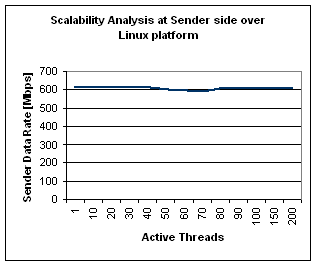
In order to work with the max data rate we used the parameters that permit to reach the D-ITG best performance (C=75000pkt/s e c=1024 byte, Max Data Rate equal to 612 Mbps and error rate equal to 0.4%). In the case of 'n' flows/threads in order to maintain the same max value of data rate we configured each flow with a packet rate equal to 75000/n pkt/s. Figure 1 shows that the data rate is almost constant and equal to the maximum data rate when the number of flows is varying. We can conclude that the D-ITG Linux Sender presents optimal scalability properties.
 |
 |
|
Figure 1: Scalability Analysis at Sender side over Linux platform |
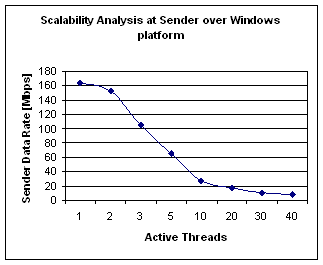
Figure 2: Scalability analysis at sender side over Windows Platform |
Scalability analysis at sender side over Windows Platform
In this case we set up our experimentation in the same way of the Linux platform. In order to work with the max data rate we used the parameters that permit to reach the D-ITG best performance over Windows platform (C=20000pkt/s e c=1024 byte, Max Data Rate equal to 163 Mbps and error rate equal to 1.5%). In the case of 'n' flows/threads in order to maintain the same max value of data rate we configured each flow with a packet rate equal to 20000/n pkt/s. Figure 2 shows that over Windows platform there is a considerable degradation of the performance with respect to D-ITG implementation over Linux platform. Comparing Figure 1 and Figure 2 it is simple to understand that the D-ITG Windows Sender is less scalable than D-ITG Linux Sender.
Scalability analysis at receiver side over Linux Platform
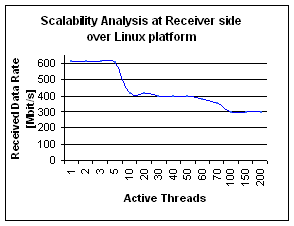
In this case we used the same number of threads used in the D-ITG Linux Sender analysis. Figure 3 shows that up to five flows the receiver capabilities are the same as that achieved with one flow. In the worst case, when the number of flows is equal to 200 we measured a data rate equal to 278 Mbps.
Scalability analysis at receiver side over Windows Platform
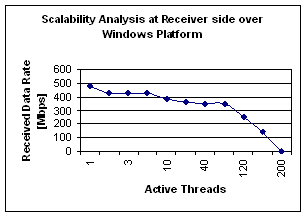
In this case, in order to analyze the scalability of the receiver we used the Linux ITGSend. This choice was motivated by the following reasons: (i) D-ITG Linux Sender presents higher performance than D-ITG Windows Sender; ( ii) the D-ITG Windows Sender is less scalable than D-ITG Linux Sender. In the case of a single flow/thread we measured a received data rate equal to 480 Mbps. In the case of two flows/threads we observed a reduction equal to 10% (Figure 4). Observing Figure 3 and Figure 4 we can conclude that the D-ITG Windows Receiver is less scalable than D-ITG Linux Receiver, but - in the case of Windows platform - with respect to the sender the receiver shows more acceptable scalability property.
 |
 |
|
Figure 1: Scalability analysis at Receiver side over Linux platform |
Figure 2: Scalability analysis at Receiver side over Windows platform |