

Windows Platform: local experimentation
Local experimentation with logging only at receiver side
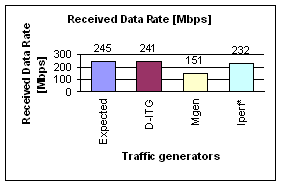
Over Windows platform and by using the log file at the receiver side, D-ITG presents the performance depicted in Figure 1.
 |
|
Figure 1: Comparative analysis of local received data rate over Windows platform (log at receiver side) |
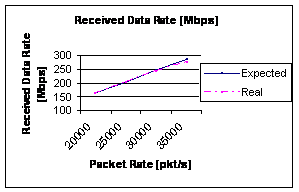
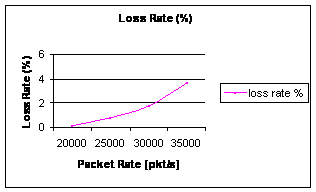
In the case of C=30000pkt/s, c=1024byte, t=60s D-ITG reaches a received data rate equal to 241Mbit/s with a percentage loss rate equal to 1.8%. At the same received data rate Iperf and Mtools present respectively a loss rate equal to 38% and 5.3%. In addition, in section 4.1.1 we have already clarified that the Iperf logging process does not permit a complete performance analysis. In Figure 2 the percentage loss rate (between real and expected data rate) as a function of packet rate is reported. In Figure 3 the percentage loss rate trend is depicted.
 |
 |
|
Figure 2: Local received data rate over Windows platform (log at receiver side) |
Figure 3: Local loss rate (%) over Windows platform (log at receiver side) |
Local experimentation with logging both at receiver and sender side
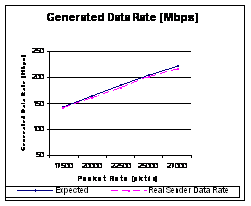
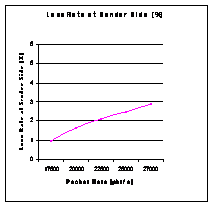
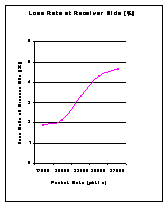
In this subsection we can analyze only D-ITG because there are not traffic generators, over Windows platform, that can log both at sender and receiver side. In this case, D-ITG presents a reduction of 102 Mbps (Figure 4). Indeed in this case, with a percentage loss rate equal to 1.8%, we had a max data rate equal to 143 Mbps for 17500 pkt/s (in the previous case for the same percentage loss rate we had a max data rate equal to 245 Mbps for 30000 pkt/s). In Figure 5 and in Figure 6 the percentage loss rate respectively at sender and receiver side is depicted.
Before to study the performance in a distributed testbed, we can conclude that under the same conditions, over Windows platforms the maximum data rate is less than maximum value over Linux platforms.
 |
 |
 |
|
Figure 4: Local generated data rate over Windows platform (log both sender and receiver side) |
Figure 5: Local loss rate (%) at sender side over Windows platform (log both sender and receiver side) |
Figure 6: Local loss rate (%) at receiver side over Windows platform (log both sender and receiver side) |
Windows Platform: distributed experimentation
In this subsection we describe the results of the distributed experimentation over Windows platform. In this case we used the same operational mode of the section "Windows Platform: local experimentation".
Distributed experimentation with logging only at receiver side
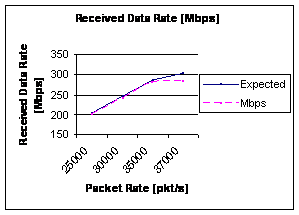
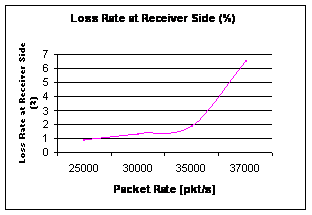
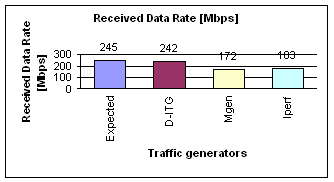
Between two Windows devices and by using the log file at the receiver side D-ITG present the performance depicted in Figure 7. In Figure 8 a percentage loss rate (between real and expected data rate) as a function of packets per second number is reported. In the case of C=30000pkt/s, c=1024byte, t=60s D-ITG reaches a received data rate equal to 242Mbit/s with a percentage loss rate equal to 1.4%.
 |
 |
|
Figure 7: Received data rate over Windows platform (distributed and log at receiver side) |
Figure 8: Loss rate (%) trend over Windows platform (distributed and log at receiver side) |
It is important to note that also over two distinct devices D-ITG is able to reach its higher performance. Figure 9 shows a comparative analysis between traffic generators over two distinct devices: also in this c ase D-ITG presents the highest performance.
 |
|
Figure 9:Comparative analysis of received data rate over Windows devices (distributed and log at receiver side) |
Distributed experimentation with logging both at receiver and
sender side
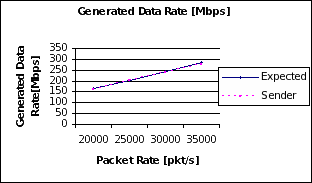
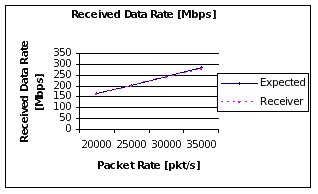
D-ITG is the only traffic generator that, over Windows platform, permits to log both at sender and receiver side. Thus, over two distinct Windows devices and by using log file both at receiver and sender side D-ITG presents the performance depicted in Figure 10 (sender) and in Figure 11 (receiver).
 |
 |
|
Figure 10: Generated data rate over Windows platforms (distributed and log at sender and receiver side) |
Figure 11: Received data rate over Windows platforms (distributed and log at sender and receiver side) |